





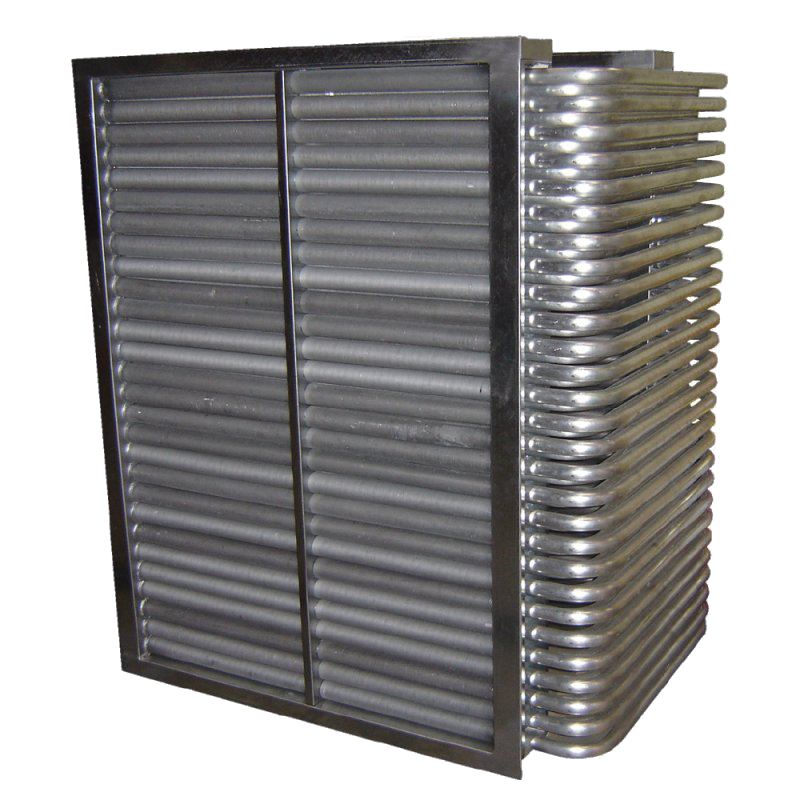
A must for any dehumidification applications!
A must for any dehumidification applications to help reducing your energy bills!
FEATURES AND BENEFITS
- High effectiveness for rapid payback
- Integral fin technology for long lasting, reliable performances
- Tough and easy to clean product
- Most compact energy recovery component
- No moving parts for virtually maintenance free operation
- No external power required

With ASHRAE Standard 62 (Ventilation for Acceptable Air Quality) , new efforts were introduced to increase indoor air quality. These changes inevitably lead to more outdoor air being brought into buildings and consequently greatly affected the heating, cooling and dehumidification costs.
Luckily, ways to offset these increases were also developed and to-day, heat wheels, flat plate exchangers and standard heat pipes are widely used to help reduce heating and cooling costs. Concerning dehumidification, the most commonly used solution remains the Thermogain wrap-around heat pipe (TWHP).
Each of our Thermogain wrap-around heat pipe is specifically designed around your cooling coil dimensions which mean a very compact and easy to install component (even for retrofit jobs). Moreover, their full aluminum tube with integrally turned fins' construction requires no external connection or power; your best guaranty to a long lasting, trouble free product. In addition, not only does our Thermogain wrap-around heat pipe help in greatly reducing operating costs, their incorporation in new systems usually means a down-sized cooling coil which significantly reduces payback periods.
OPTIONS
- Stainless steel casings
- Heresite phenolic coating
Datasheets and other product documentation in the Library section.
OPERATING PRINCIPLE
Unlike standard energy recovery components, TWHP does not recover energy from one airstream to another but rather transfers it from one point to another within the same airflow. On the free pre-cool side (location A to B), the TWHP greatly helps in reducing the outdoor air temperature, bringing it close to its dew point. On the free reheat side (location C to D), it uses the heat contained in the outdoor air to re-heat the air from the cooling coil to comfortable levels. The end result being great energy savings and reduced operating costs.
BASE THEORY
In each individual tube, evaporation occurring on the Evaporator End creates a pressure gradient that forces the vapor to a remote area called the Condenser End. The vapor, now on the Condenser End and subject to much colder temperatures, condensates on the inner tube surface and returns, with the help of capillary pumping forces within the wick structure, to the Evaporator End to complete the cycle. The result is a perpetual motion machine without moving parts and requiring no energy of its own.
DOWNLOAD AND DOCUMENT
Visit our library to learn more about this product
CERTIFICATION

 UL 207
